
AMSOIL vs. Shell: (Rotella T6 & Helix)
Deciding between AMSOIL and Shell lubricants for your vehicle or equipment? Learn how AMSOIL and Shell lubricants compare here.
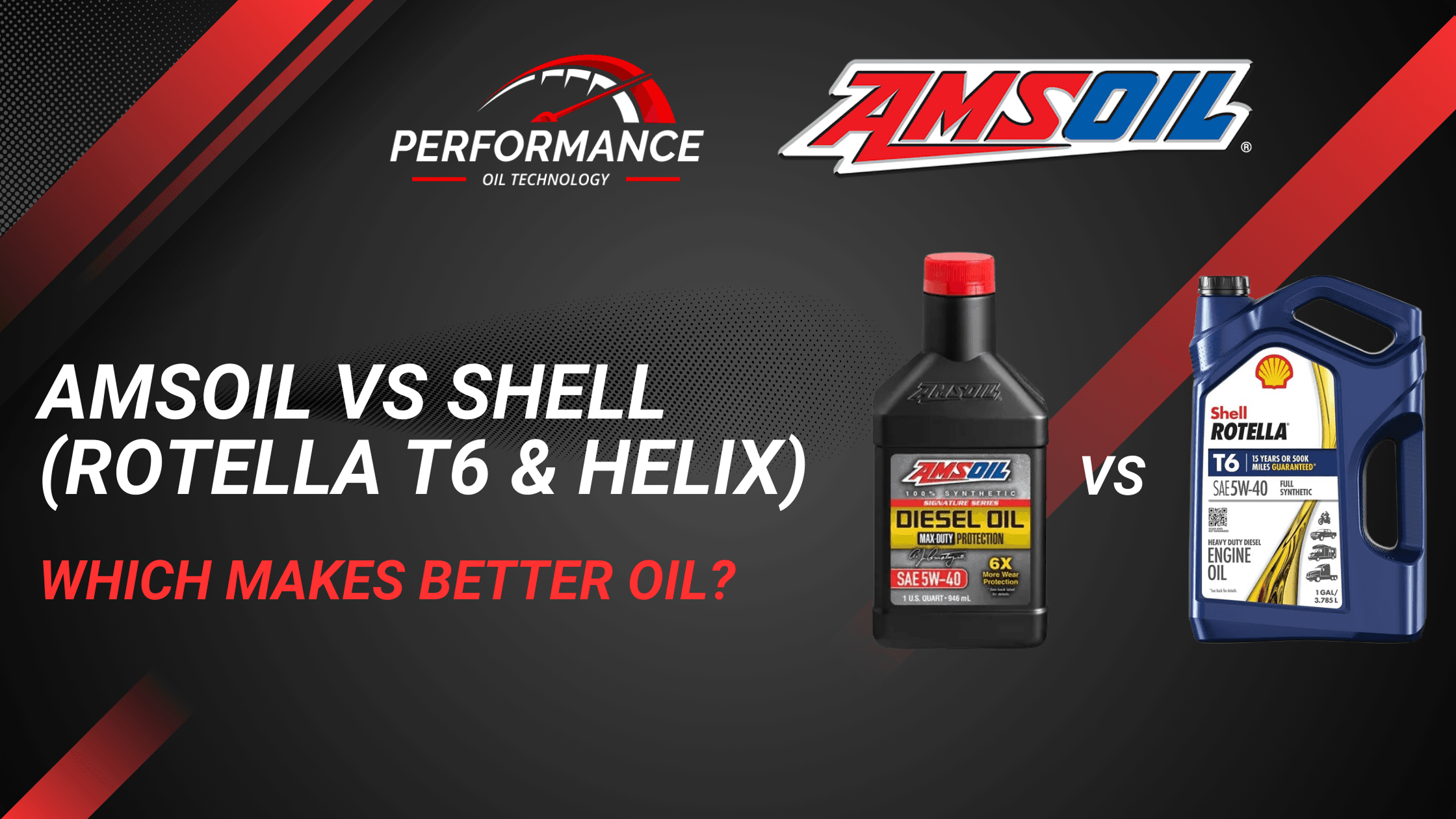
AMSOIL and Shell are some of the most popular diesel lubricant companies in the industry. AMSOIL covers the gamut of diesel lubrication applications with their Signature Series line and Shell does the same with their Rotella oils.
If you're comparing AMSOIL vs. Shell for any lubricant application, you're in the right place. We'll be stacking up AMSOIL vs. Shell Rotella, Helix, and other oil lines to help you determine which is the best for your vehicle.
The Companies Behind the Bottles
Before diving into specific products, let's understand the companies we're comparing.
AMSOIL: America's Synthetic Pioneer
AMSOIL was founded in 1969 by jet fighter squadron commander Al Amatuzio, who recognized that the synthetic lubricants used in jets could benefit automotive applications. The company made history by creating the first API-qualified synthetic motor oil for automotive use. As an American company, AMSOIL has focused almost exclusively on premium synthetic lubricants for over 50 years.
Shell: Global Energy Giant
Shell has a longer history, beginning with its formation in 1907 through the merger of Royal Dutch Petroleum and the "Shell" Transport and Trading Company. While primarily an oil and gas producer, Shell's lubricant division has grown substantially and now comprises nearly 40% of their business. Their Rotella brand for diesel applications and Helix line for passenger cars are some of their flagship lubricant products.
Technical Oil Comparisons
During my time at Ford working on truck programs, I gained extensive experience with diesel engines. Let's compare the premium diesel offerings from both companies.
AMSOIL Signature Series 5W-40 Max Duty Diesel vs. Shell Rotella T6 Full Synthetic 5W-40
Both of these oils target the heavy-duty diesel market, but there are significant differences in performance:
| Oil Specifications | AMSOIL SS 5W-40 | Shell Rotella T6 5W-40 |
|---|---|---|
| Kinematic Viscosity @ 100°C, cSt (ASTM D445)Kinematic Viscosity is defined as an oil's resistance to flow and shear due to gravity. At high temperatures, higher viscosity is better for protection. | 15.4 | 14.9 |
| Kinematic Viscosity @ 40°C, cSt (ASTM D445)Kinematic Viscosity is defined as an oil's resistance to flow and shear due to gravity. At high temperatures, higher viscosity is better for protection. | 94.5 | 90 |
| Viscosity Index (ASTM D2270)Viscosity Index measures the variation in kinematic viscosity due to changes in temperature. Higher viscosity index equates to a smaller decrease in kinematic viscosity with increasing temps. | 173 | 167 |
| Cold Crank Viscosity (CCS), cP @ (°C) (ASTM D5293)CCS measures the oil's ability to flow while cranking an engine (simulated) at cold temperatures, the lower the better. | 5555(-30) | 6300(-30) |
| Pour Point, °C(°F) (ASTM D97)Pour Point represents the lowest temperature at which oil flows in a specified lab test. | -43(-45) | -51(-60) |
| Flash Point, °C(°F) (ASTM D92)Flash Point is the lowest temperature at which a substance will generate vapors that when exposed to a flame will momentarily ignite and self-extinguish. | Not Listed | 233(451) |
| NOACK Volatility, % weight loss (ASTM D5800)NOACK Volatility measures oil evaporation at high temperatures. Lower values indicate less evaporation and oil consumption. | 9.2 | Not Listed |
| Four-Ball Wear Test, mm (ASTM D4172)Four-Ball Wear Test measures the wear protection properties of a lubricant. A smaller wear scar indicates better protection. | 0.46 | Not Listed |
| High-Temperature/High-Shear Viscosity @150°C, cP (ASTM D5481)HTHS Viscosity measures oil film strength under high temperature and high shear conditions. Higher values indicate better protection. | 4.3 | Not Listed |
| Total Base Number (TBN) (ASTM D2896)TBN indicates the oil's reserve capacity to neutralize acids. Higher values suggest longer-lasting protection against corrosion. | 10.1 | 10.2 |
| Sulfated Ash Content, wt. %Sulfated Ash Content indicates the amount of metallic additives in the oil. Important for emissions system compatibility. | 0.99 | 1.0 |
| Service Life Guarantee | Up to 3X OEM recommendations | OEM recommended intervals |
Based on the technical specifications, both AMSOIL Signature Series 5W-40 Max Duty Diesel and Shell Rotella T6 5W-40 are premium synthetic diesel oils, but with some notable differences:
AMSOIL Signature Series Max Duty Diesel advantages:
- Higher kinematic viscosity at both 40°C and 100°C, providing slightly better oil film thickness
- Lower cold cranking viscosity (5555 vs 6300 cP), suggesting easier engine starts in cold weather
- Published wear protection data through the Four-Ball Wear Test (0.46mm)
- Extended drain intervals up to 3X OEM recommendations, potentially reducing maintenance costs
- Higher Viscosity Index of 173 vs Shell T6 at 167 provides higher resistance to shearing and less change viscosity breakdown with increasing temperatures
Shell Rotella T6 Heavy Duty Diesel advantages:
- Superior pour point (-51°C vs -43°C), offering better flow in extreme cold conditions
- Slightly higher TBN (10.2 vs 10.1), though the difference is minimal
Pricing - AMSOIL Diesel vs. Shell Rotella T6
Even with a Preferred Customer membership discount, you can expect to pay a bit more per quart for AMSOIL Max Duty Diesel compared to Shell Rotella T6. But, that additional cost is far outweighed by the savings you'll get from extending your drain interval up to 2X the OEM recommendations (not to exceed 25,000 miles or one-year whichever comes first) for turbodiesel pickup trucks and up to 3X OEM recommendations (not to exceed 60,000 miles or one-year, whichever comes first) for heavy duty on and off road diesels.
Assuming a heavy duty diesel OEM recommendation of 7,500-10,000 miles, and an annual 60,000 miles driven, you would save upwards of $300 running AMSOIL Signature Series Max Duty Diesel compared to Shell Rotella T6. Note that oil analysis testing is recommended to extended intervals beyond the AMSOIL specifications..
Key Takeaways - AMSOIL Max Duty Diesel vs. Shell Rotella T6
- Cold Weather Performance: Shell has a better pour point, but AMSOIL has better cold cranking properties - an interesting trade-off depending on your climate and typical starting conditions.
- Protection Data: AMSOIL provides more comprehensive protection metrics (NOACK, Four-Ball Wear, HTHS, Viscosity Index) that Shell doesn't publish, suggesting confidence in their formulation's performance.
- Service Life: The most significant practical difference is AMSOIL's extended drain interval capability, which could translate to fewer oil changes and lower long-term costs despite a potentially higher initial purchase price.
- Similar Additive Packages: Nearly identical TBN and sulfated ash content suggest similar approaches to acid neutralization and emissions system compatibility.
- AMSOIL has a higher Viscosity Index providing less change in viscosity with increasing temperatures and better resistance to shearing.
For diesel truck owners, the choice might come down to operating conditions and maintenance preferences rather than dramatic performance differences, with AMSOIL offering potential long-term value through extended drain intervals.
Passenger Car Motor Oil Comparison
AMSOIL Signature Series vs. Shell Helix Ultra Professional AF
For passenger vehicles with gas engines, AMSOIL's flagship Signature Series goes head-to-head with Shell's premium Helix Ultra line:
| Oil Specifications | AMSOIL SS 5W-20 | Shell Helix Ultra 5W-20 |
|---|---|---|
| Kinematic Viscosity @ 100°C, cSt (ASTM D445)Kinematic Viscosity is defined as an oil's resistance to flow and shear due to gravity. At high temperatures, higher viscosity is better for protection. | 8.8 | 7.20 |
| Kinematic Viscosity @ 40°C, cSt (ASTM D445)Kinematic Viscosity is defined as an oil's resistance to flow and shear due to gravity. At high temperatures, higher viscosity is better for protection. | 50.6 | 42.60 |
| Viscosity Index (ASTM D2270)Viscosity Index measures the variation in kinematic viscosity due to changes in temperature. Higher viscosity index equates to a smaller decrease in kinematic viscosity with increasing temps. | 153 | Not Listed |
| Cold Crank Viscosity (CCS), cP @ (°C) (ASTM D5293)CCS measures the oil's ability to flow while cranking an engine (simulated) at cold temperatures, the lower the better. | 4385(-30) | Not Listed |
| Pour Point, °C(°F) (ASTM D97)Pour Point represents the lowest temperature at which oil flows in a specified lab test. | -50(-58) | -36(-33) |
| Flash Point, °C(°F) (ASTM D92)Flash Point is the lowest temperature at which a substance will generate vapors that when exposed to a flame will momentarily ignite and self-extinguish. | 220(428) | 232(450) |
| NOACK Volatility, % weight loss (ASTM D5800)NOACK Volatility measures oil evaporation at high temperatures. Lower values indicate less evaporation and oil consumption. | 5.8 | Not Listed |
| High-Temperature/High-Shear Viscosity @150°C, cP (ASTM D5481)HTHS Viscosity measures oil film strength under high temperature and high shear conditions. Higher values indicate better protection. | 2.67 | Not Listed |
| Total Base Number (TBN) (ASTM D2896)TBN indicates the oil's reserve capacity to neutralize acids. Higher values suggest longer-lasting protection against corrosion. | 12.5 | Not Listed |
| Density, kg/m³ @ 15°C | Not Listed | 849.8 |
| Service Life Guarantee | 25,000 miles/1 year | OEM recommended intervals |
Based on this technical comparison between AMSOIL Signature Series 5W-20 and Shell Helix Ultra Professional AF 5W-20, here's a brief analysis:
- Viscosity Characteristics: AMSOIL has notably higher viscosity measurements at both 40°C and 100°C compared to Shell, which suggests it may provide better protection at operating temperatures.
- Cold Weather Performance: AMSOIL shows superior cold weather performance with a significantly lower pour point (-50°C vs -36°C), indicating better flow characteristics in extreme cold conditions.
- High Temperature Stability: Shell has a slightly higher flash point than AMSOIL, though both oils demonstrate excellent high-temperature stability.
- Longevity Factors: AMSOIL provides data on important longevity metrics like NOACK Volatility, HTHS, and TBN that Shell doesn't publish in their data sheet, making it difficult to compare these important properties.
- Service Life: AMSOIL clearly states an extended drain interval up to 25,000 miles while Shell recommends following OEM intervals, typically between 3,000-7,500 miles for most passenger vehicles.
Pricing - AMSOIL Signature Series vs. Shell Helix
Out of the gate, the Shell Helix Ultra Professional AF 5W-20 is a bit more expensive than the AMSOIL Signature Series 5W-20 at Preferred Customer pricing. When you account for the extended drain intervals (25,000 for AMSOIL vs. OEM interval for Shell Helix) you can save upwards of $100 per year running AMSOIL over Shell Helix. From the technical comparison we've done above, you'll save money and you'll be running a higher quality oil with AMSOIL Signature Series.
Value Comparison: Beyond the Price Tag
When comparing AMSOIL and Shell products, it's essential to look beyond the initial purchase price:
Extended Drain Intervals: AMSOIL Signature Series' 25,000-mile drain interval means you're buying (and changing) oil less frequently compared to Shell products, where Shell universally recommends following the OEM-recommended service intervals for nearly all their oils (except for their extended drain interval program which requires OEM approval through regular oil analysis and review).
Preferred Customer Program: AMSOIL's Preferred Customer program provides up to 25% savings on products and free shipping on qualifying orders. Shell doesn't offer a comparable direct purchasing program.
Long-term Engine Protection: From my engineering perspective, the superior protection provided by AMSOIL products can significantly extend engine life and reduce maintenance costs over the vehicle's lifetime. This is particularly important in high-value vehicles or equipment used for business.
My Engineering Assessment
Based on my time as a Ford engineer working on vehicle testing and development, I've developed a deep understanding of what makes a quality lubricant. When I examine the technical specifications, test results, and real-world performance of both companies' products, I see the following key differences:
- Formulation Philosophy: AMSOIL designs products from the ground up to maximize protection and performance, often exceeding OEM requirements. Shell products are excellent but typically focused on meeting (rather than significantly exceeding) manufacturer specifications.
- Base Oil Quality: AMSOIL primarily uses higher-quality Group IV (PAO) synthetic base oils in many of their premium products, while Shell often uses a mix of Group III and Group IV bases in their synthetic offerings.
- Additive Technology: Both companies have proprietary additive packages, but AMSOIL's typically contain higher concentrations of anti-wear additives like ZDDP where appropriate.
Personal Experience in My Fleet
Throughout my career and as an AMSOIL Dealer, I've worked with many thousands of turbodiesel and heavy duty diesel customers who changed from Rotella to AMSOIL who have found that AMSOIL Max Duty Diesel provides noticeably better cold-weather starting and less soot-related viscosity increase compared to Rotella products as well as superior protection, performance, and longer drain interval specifications.
Conclusion: Which is Better?
Both AMSOIL and Shell produce high-quality lubricants that exceed minimum specifications. Shell products are widely available and provide very good protection at a reasonable price point. For many average consumers who follow manufacturer-recommended drain intervals and don't push their equipment to extremes, Shell products will serve them well.
However, for those seeking maximum protection, extended drain intervals, extreme temperature performance, or specialized applications, AMSOIL holds a clear technical advantage. The company's singular focus on premium synthetic lubricants results in products that consistently outperform in technical testing and real-world applications.
For my personal vehicles and equipment, I exclusively use AMSOIL products because the engineering and testing data and my personal experience confirm they provide superior protection and value over the long term.
Recommendations Based on Need:
- For average drivers following regular drain intervals: Either brand will provide good protection, with Shell offering good value and accessibility.
- For those seeking maximum protection and extended drain intervals: AMSOIL Signature Series offers superior performance and value despite the higher initial cost.
- For powersports and specialized applications: AMSOIL's application-specific formulations provide advantages that can be felt in performance and long-term reliability.
- For diesel trucks, especially in extreme conditions: AMSOIL Premium Diesel offers superior protection against soot-related issues and better cold-weather performance.
As an engineer who's spent decades testing vehicles and studying lubricants, I believe the data speaks for itself. While both are quality products, AMSOIL's technical advantages make it the superior choice for those who want the absolute best protection for their vehicles and equipment. For the protection you demand, and the performance you deserve, choose AMSOIL.

Meet The Author
Hi, I'm Dave - a former Ford Truck/Automotive Engineer with 40 years of combined professional experience working with lubrication systems and using and promoting AMSOIL products. My trucks, heavy equipment, farm and powersports vehicles experience extreme use, and I use AMSOIL products in every single one. Enjoy the site!
Related Articles
AMSOIL vs Motul: Which is best?
We compared AMSOIL with Motul to see which oil is higher quality and worth your money....
Best oil for Harleys? AMSOIL vs Harley Oil
Trying to find the best oil for your Harley-Davidson? Compare oils and find the best AMSOIL fluid for your bike here....
Lucas Oil vs AMSOIL: Who makes better motor oil & additives?
How does Lucas Oil stack up with AMSOIL? Why doesn't AMSOIL make engine oil additives? Answers to these and more in this...